
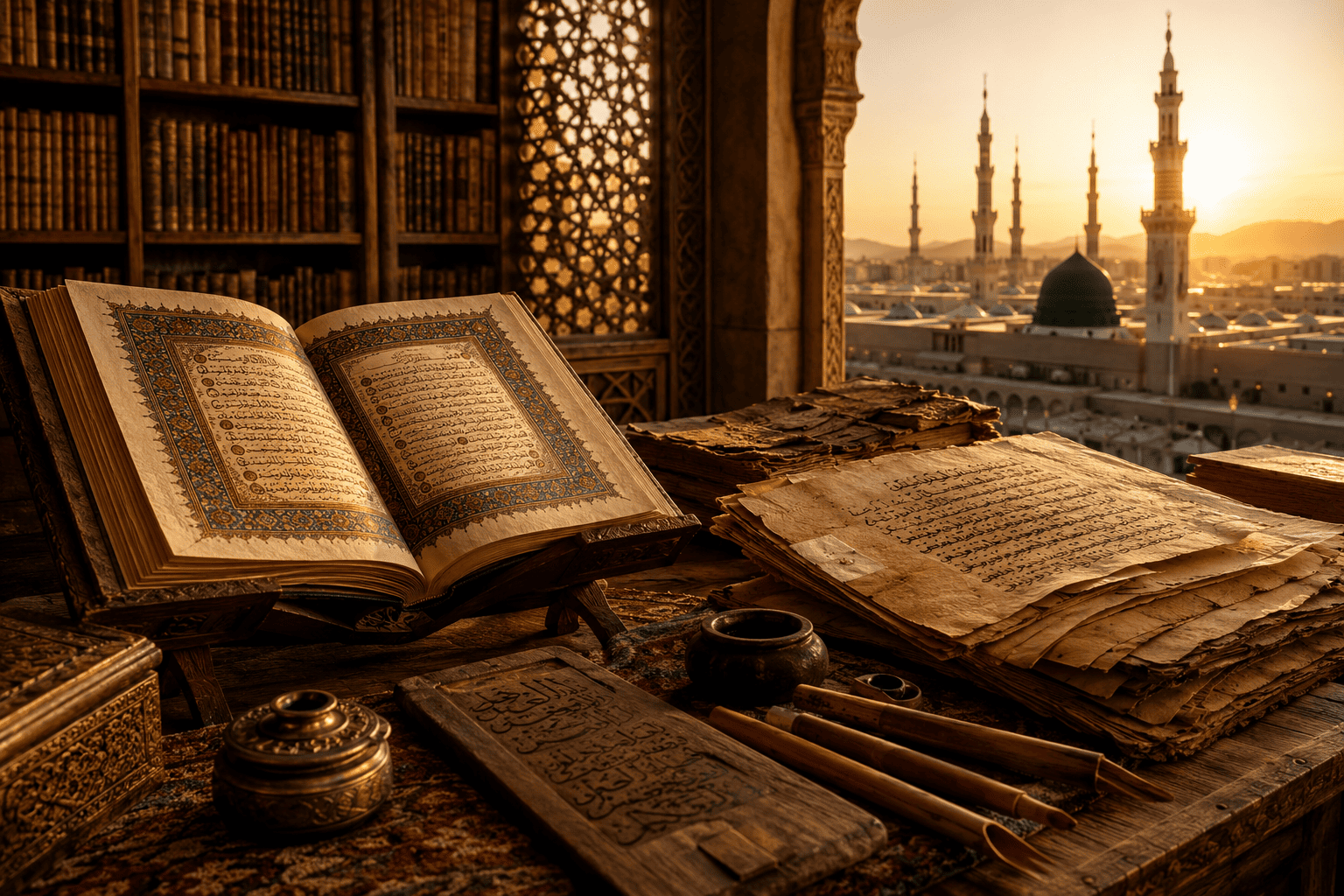
Some critics claim that the Qur'an was altered after the death of Prophet Muhammad (peace and blessings be upon him), that verses were lost or changed, and that today's Qur'an is not identical to the revelation originally delivered to him.
The ResponseThe Preservation of the Qur'an: History, Manuscripts, and Authentic Evidence
Introduction
The Qur'an occupies a unique position within Islam. Muslims believe it to be the literal word of Allah revealed to Prophet Muhammad (peace and blessings be upon him) over approximately twenty-three years through the Angel Jibril (Gabriel). Unlike earlier revelations, which Muslims believe were altered or partially lost over time, the Qur'an is understood to have been preserved by divine promise. Because of this belief, questions regarding the preservation of the Qur'an are among the most frequently raised by both critics and students of Islamic history. Some claim that the Qur'an underwent substantial changes after the Prophet's death. Others argue that early manuscripts differ significantly from today's text or that Caliph Uthman created an entirely new version of the Qur'an.
These claims deserve careful examination.
Responsible historical study begins with the earliest available evidence rather than assumptions or isolated quotations. It also distinguishes between textual preservation, methods of transmission, manuscript history, and scholarly interpretation.
This article examines:
- What the Qur'an says about its own preservation.
- How revelation was recorded during the Prophet's lifetime.
- The role of memorization in preserving the text.
- The compilation of the Qur'an after the Prophet's death.
- The Uthmanic codex.
- Early Qur'anic manuscripts.
- Modern academic research.
- Frequently raised objections and responses.
What Does the Qur'an Say About Its Preservation?
The first question should be whether the Qur'an itself makes any claim concerning preservation.
It does.
Allah says:
"Indeed, it is We who sent down the Reminder, and indeed, We will surely preserve it."
(Qur'an 15:9)
For Muslims, this verse forms the theological foundation of belief in the preservation of the Qur'an.
Another passage states:
"Falsehood cannot approach it from before it or from behind it. It is a revelation from the All-Wise, the Praiseworthy."
(Qur'an 41:42)
The Qur'an repeatedly presents itself as divine revelation protected from corruption and intended as guidance for humanity.
Whether one accepts this claim as a matter of faith is separate from the historical question of how the text was transmitted.
Historians therefore examine the historical processes through which the Qur'an was preserved.
Revelation During the Lifetime of the Prophet
The Qur'an was not revealed all at once. Instead, revelation occurred gradually over approximately twenty-three years between 610 CE and 632 CE.
Whenever verses were revealed, Prophet Muhammad immediately recited them to his Companions. The revelation was preserved through two complementary methods.
Memorization
Arabian society possessed a highly developed oral culture. Poetry, genealogy, legal agreements, and historical traditions were frequently memorized with remarkable precision. The Qur'an was learned in the same environment. Many Companions memorized large portions of the revelation during the Prophet's lifetime.
Among the most well-known memorizers were:
- Abu Bakr al-Siddiq
- Umar ibn al-Khattab
- Uthman ibn Affan
- Ali ibn Abi Talib
- Abdullah ibn Mas'ud
- Ubayy ibn Ka'b
- Zayd ibn Thabit
- Abu Musa al-Ash'ari
The Prophet regularly listened to recitations, corrected mistakes, and reviewed the Qur'an with the Angel Jibril every Ramadan. According to authentic hadith, this review occurred twice during the final year of his life. This continuous process of recitation and correction significantly reduced the possibility of accidental textual change. Today, this tradition continues through ḥifẓ, the memorization of the entire Qur'an by millions of Muslims around the world.
Written Revelation
Although memorization played a central role, the Qur'an was also recorded in writing during the Prophet's lifetime. The Prophet appointed several Companions as official scribes of revelation.
Among the most prominent were:
- Zayd ibn Thabit
- Ubayy ibn Ka'b
- Mu'awiyah ibn Abi Sufyan
- Khalid ibn al-Walid
- Ali ibn Abi Talib
Verses were written on available materials including:
- parchment,
- leather,
- shoulder blades of animals,
- palm stalks,
- smooth stones,
- and wooden tablets.
Whenever new revelation arrived, the Prophet instructed the scribes where each passage belonged within the existing chapters. This arrangement distinguishes the Qur'an from ordinary historical documents that were later organized by editors. According to Islamic tradition, the order of verses was determined under prophetic guidance.
Why Was the Qur'an Not Immediately Collected into One Book?
This question is often asked by both Muslims and non-Muslims.
The answer lies in the nature of revelation itself.
Because revelation continued throughout the Prophet's life, a permanently bound manuscript could not yet be produced.
New verses continued to be revealed.
Some legal rulings superseded earlier ones.
The order of revelation did not always correspond to the final arrangement of chapters.
Only after the Prophet's death when revelation had ceased could the complete text be collected into a single manuscript while preserving the arrangement taught by the Prophet.
This distinction is important.
The Qur'an existed completely during the Prophet's lifetime, but it existed primarily as a combination of widespread memorization together with numerous written records rather than one bound volume.
The Compilation Under Abu Bakr
Shortly after the Prophet's passing in 632 CE, several tribal rebellions erupted. During the Battle of Yamamah, many Muslims who had memorized the Qur'an were killed. According to authentic narrations preserved in Sahih al-Bukhari, Umar ibn al-Khattab became concerned that if more memorizers died in future battles, portions of the Qur'an might become difficult to preserve through oral transmission alone. He therefore advised Caliph Abu Bakr to commission an official written collection. Initially, Abu Bakr hesitated because the Prophet himself had never ordered such a compilation. After careful consideration, however, he concluded that preserving the revelation justified the effort. The responsibility was entrusted to Zayd ibn Thabit, one of the Prophet's principal scribes. Zayd later described the task as one of the most demanding responsibilities he had ever undertaken. He did not simply gather personal notes. Instead, he employed a careful verification process.
Among the methods described in the early sources were:
- collecting written materials recorded during the Prophet's lifetime,
- confirming passages through multiple witnesses,
- comparing written copies with memorized recitations,
- and ensuring agreement with the established oral tradition.
The completed manuscript remained with Abu Bakr, later passed to Umar, and eventually came into the possession of Hafsah bint Umar.
This compilation formed the basis for the next major stage in the history of the Qur'an. Part -2 will continue
As is the case with all my endeavors, whatever is correct in this work is from Allah alone, while any error is from myself and the whispers of Shayṭān. I ask Allah to rectify my shortcomings and ask that He perfect this work in accordance with the guidance of His Messenger (peace and blessings be upon him).