Some critics claim that the Qur'an was altered after the death of Prophet Muhammad (peace and blessings be upon him), that verses were lost or changed, and that today's Qur'an is not identical to the revelation originally delivered to him.
The Response(Continued)
The Uthmanic Codex
Following the compilation under Caliph Abu Bakr, the collected manuscript remained with him until his death. It then passed to Caliph Umar ibn al-Khattab and, after his death, to his daughter Hafsah bint Umar, one of the wives of Prophet Muhammad (peace and blessings be upon him). As Islam expanded beyond the Arabian Peninsula into Iraq, Syria, Egypt, Persia, and Armenia, Muslims from different regions learned the Qur'an from different Companions. These Companions had taught the Qur'an according to the recognized dialectical variations (aḥruf) permitted during the Prophet's lifetime. While these variations were legitimate, new Muslims who were unfamiliar with their background sometimes assumed that another person's recitation was incorrect. According to authentic narrations preserved in Sahih al-Bukhari, during military campaigns in Armenia and Azerbaijan, the Companion Hudhayfah ibn al-Yaman witnessed disagreements in recitation among Muslim soldiers from different regions. Concerned that these disagreements might eventually resemble the textual disputes that had affected earlier religious communities, he urged Caliph Uthman ibn Affan to establish an official reference copy. His concern was not that the Qur'an had become corrupted, but that regional differences in pronunciation and dialect could create confusion among later generations.
The Standardization Under Uthman
Caliph Uthman formed a committee headed once again by Zayd ibn Thabit. Other members included Abdullah ibn al-Zubayr, Sa'id ibn al-'As, and Abd al-Rahman ibn al-Harith ibn Hisham. The committee used the manuscript compiled under Abu Bakr, preserved by Hafsah, as the primary reference. Their task was not to produce a new Qur'an. Rather, it was to prepare standardized copies of the already established text using the dialect of Quraysh where differences in pronunciation or orthography existed.
Several official copies were then sent to major centers of the Islamic world, including:
- Madinah
- Makkah
- Kufa
- Basra
- Damascus
Qualified reciters accompanied these manuscripts to teach their proper recitation.
Why Were Other Personal Copies Removed?
One of the most frequently misunderstood events in Qur'anic history is Uthman's order to destroy unofficial written materials.
The earliest Islamic sources, however, present a different picture.
Many Companions possessed personal collections for study and teaching. These often contained:
- personal notes,
- explanatory comments,
- different arrangements of surahs,
- incomplete collections,
- or writing intended for private use rather than public distribution.
Because these personal materials could easily be mistaken for official copies by later generations, Uthman ordered that unofficial written materials be withdrawn after the standardized copies had been distributed. This action resembles replacing multiple unofficial classroom notes with an officially verified edition of a textbook. It was intended to prevent future confusion rather than alter the revealed text. No authentic early source reports that Uthman introduced new chapters, removed authentic chapters, or rewrote the Qur'an.
Did Uthman Create a New Qur'an?
This allegation occasionally appears in polemical literature. The historical evidence does not support it.
Several observations are significant:
- Numerous Companions who had memorized the Qur'an were still alive during Uthman's caliphate.
- Leading reciters such as Ali ibn Abi Talib, Ubayy ibn Ka'b, Abdullah ibn Abbas, and many others did not report that Uthman changed the revelation.
- Ali ibn Abi Talib is reported in early historical sources to have approved Uthman's actions, stating that he would have acted similarly under the same circumstances.
Had Uthman attempted to alter the Qur'an, widespread public opposition from the Prophet's Companions would be expected. The historical record instead shows broad acceptance of the standardization process.
Qirāʾāt: Different Readings or Different Qur'ans?
One of the most common misconceptions concerns the canonical readings (Qirāʾāt). Critics sometimes claim that multiple readings prove the existence of multiple Qur'ans. This conclusion misunderstands the nature of the Qirāʾāt. The Prophet Muhammad taught that the Qur'an had been revealed in multiple accepted forms (aḥruf), accommodating the linguistic diversity of the early Arab tribes. Over time, Muslim scholars rigorously authenticated and transmitted specific recitation traditions through uninterrupted chains of qualified teachers. The ten canonical Qirāʾāt represent recognized methods of reciting the same consonantal text rather than different books.
These readings may differ in:
- pronunciation,
- vowel placement,
- grammatical inflection,
- or synonymous wording within the limits transmitted from the Prophet.
For example, one reading may use a singular form while another uses the plural, yet both preserve the same theological meaning.
Importantly:
- They do not differ regarding the number of chapters.
- They do not introduce new beliefs.
- They do not contradict one another in doctrine.
- They all trace back through authenticated chains of transmission.
For this reason, Muslim scholars distinguish between authorized canonical readings and textual corruption. The former is regarded as part of the prophetic transmission, while the latter refers to unauthorized alteration.
Early Qur'anic Manuscripts
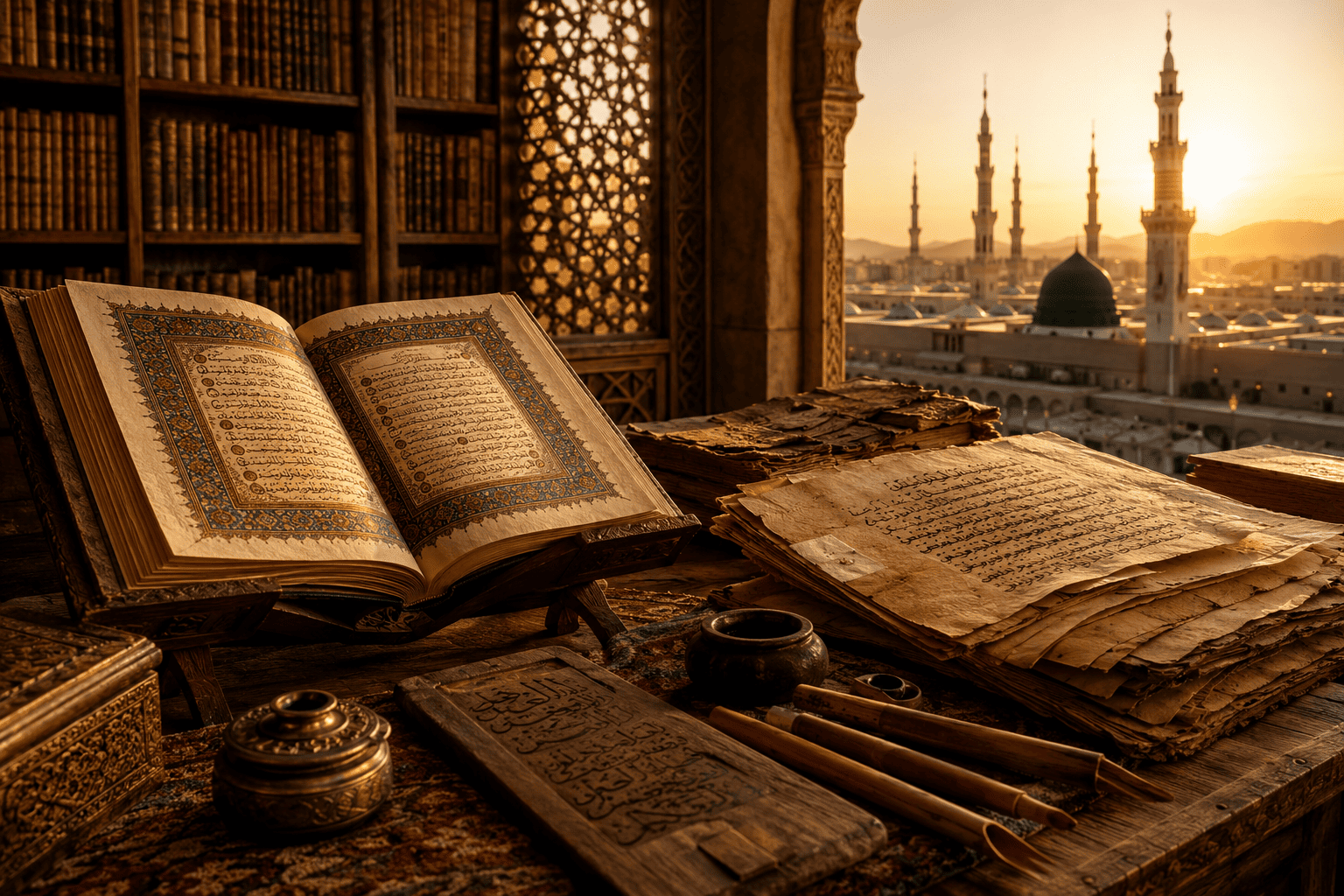
One of the strongest areas of modern research concerns surviving Qur'anic manuscripts from the first centuries of Islam. These manuscripts provide valuable historical evidence alongside the oral tradition. Among the most significant are:
The Birmingham Manuscript
Radiocarbon dating places the parchment within a range that overlaps the lifetime of Prophet Muhammad or the decades immediately following his death. The text corresponds closely with the standard Uthmanic text, supporting the conclusion that the Qur'anic text was stabilized very early.
The Ṣanʿāʾ Manuscript
Discovered in Yemen in 1972, the Ṣanʿāʾ palimpsest contains an erased lower text beneath a later upper text. Some critics initially suggested that it demonstrated major textual instability. Subsequent scholarly research has shown that most differences involve spelling conventions, orthographic practices, or recognized early textual variants rather than evidence of a fundamentally different Qur'an. Many specialists view the manuscript as evidence of the early transmission process rather than proof of corruption.
The Topkapi Manuscript
Traditionally associated with the early Uthmanic tradition, this manuscript is one of the oldest surviving Qur'anic codices. While modern scholarship debates its exact dating, its text aligns closely with the standard consonantal tradition.
The Samarkand Manuscript
Also linked by later tradition to the Uthmanic codex, the Samarkand manuscript is another early witness to the established Qur'anic text, although scholars generally date the surviving manuscript to a later Umayyad period. Together, these manuscripts demonstrate remarkable textual consistency across different regions of the early Islamic world. END OF PART-2
As is the case with all my endeavors, whatever is correct in this work is from Allah alone, while any error is from myself and the whispers of Shayṭān. I ask Allah to rectify my shortcomings and ask that He perfect this work in accordance with the guidance of His Messenger (peace and blessings be upon him).