
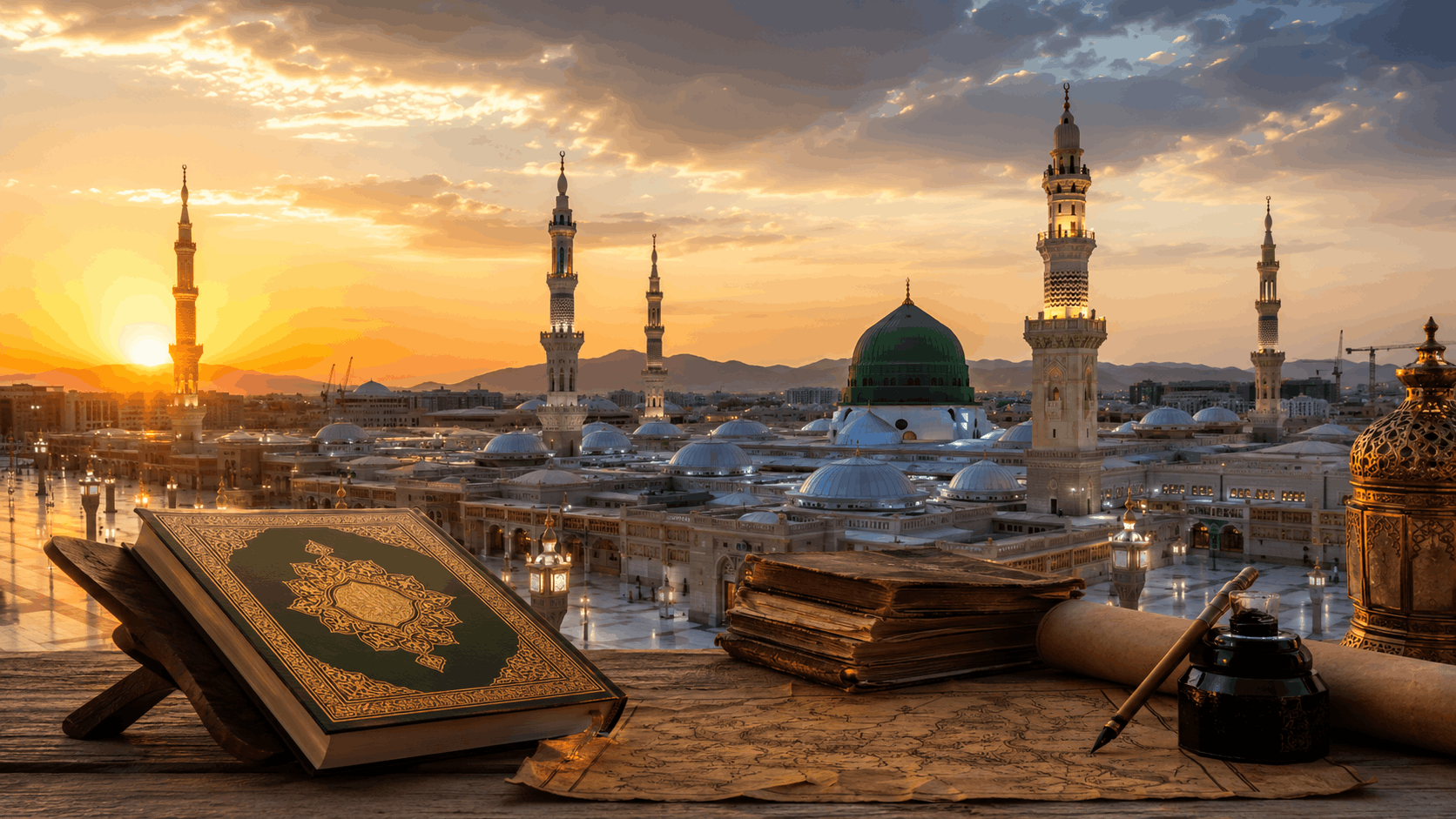
Prophet Muhammad (peace and blessings be upon him): The Mercy to the Worlds
Introduction
Few individuals have influenced human history as profoundly as Prophet Muhammad (peace and blessings be upon him). For Muslims, he is the final messenger sent by Allah to guide humanity through the revelation of the Qur'an. For historians, he was the founder of a religious civilization that reshaped Arabia and went on to influence cultures across Africa, Asia, Europe, and beyond.
Yet despite his historical significance, many people encounter his life only through isolated quotations, controversial allegations, or brief summaries that fail to capture the broader picture. Understanding Muhammad requires more than examining individual events. His life must be studied as a coherent whole—one marked by unwavering integrity, compassion, perseverance, and devotion to God.
The Qur'an describes him as:
"And We have not sent you except as a mercy to the worlds."
(Qur'an 21:107)
It also states:
"Indeed, in the Messenger of Allah you have an excellent example for whoever hopes in Allah and the Last Day and remembers Allah often."
(Qur'an 33:21)
These verses have shaped the Muslim understanding of the Prophet for more than fourteen centuries. His mission was not merely to establish a community but to call humanity to the worship of one God while embodying justice, mercy, humility, and moral excellence.
This biography explores his life chronologically, drawing primarily upon the Qur'an, authentic hadith, early sīrah literature, and recognised classical scholarship. It distinguishes between established historical evidence and later tradition while presenting the life of the Prophet within its historical context.
Arabia Before Islam
Understanding Prophet Muhammad's mission begins with understanding the world into which he was born.
The Arabian Peninsula in the sixth century was not politically united. It consisted primarily of independent tribes whose loyalties centred on kinship rather than central government. Tribal alliances provided security, while disputes between clans could continue for generations.
Religiously, most Arabs practiced various forms of polytheism. The Ka'bah in Makkah, originally built according to Islamic tradition by Prophet Ibrahim (Abraham) and his son Isma'il (Ishmael) for the worship of the One God, had become surrounded by numerous idols representing different tribes and deities.
Despite widespread idolatry, many virtues remained deeply valued within Arabian society. Honour, generosity, hospitality, courage, eloquence, and loyalty were admired qualities. At the same time, practices such as tribal warfare, social inequality, exploitation of the weak, and cycles of revenge often produced instability and injustice.
It was into this environment that Muhammad was born.
Birth and Lineage
Prophet Muhammad was born in Makkah around 570 CE, traditionally known as the "Year of the Elephant." According to early Islamic sources, this was the year in which an army led by Abraha attempted to attack the Ka'bah but failed, an event referred to in Surah al-Fīl (Qur'an 105).
He belonged to the respected Banu Hashim clan of the Quraysh tribe, custodians of the Ka'bah and one of the most influential tribes in western Arabia.
His father, Abdullah ibn Abd al-Muttalib, died before Muhammad was born. His mother, Aminah bint Wahb, cared for him during his earliest years, but she too passed away when he was approximately six years old during the return journey from Yathrib (later Madinah).
Having lost both parents at a young age, Muhammad first came under the care of his grandfather, Abd al-Muttalib. Following his grandfather's death two years later, responsibility for him passed to his uncle Abu Talib, who remained one of his strongest protectors throughout much of his life.
The experience of growing up as an orphan profoundly influenced his concern for vulnerable members of society. The Qur'an later reminded him:
"Did He not find you an orphan and give you shelter?"
(Qur'an 93:6)
Similarly, concern for orphans, widows, travellers, and the poor became a recurring theme throughout the Qur'an and the Prophet's teachings.
Early Character and Reputation
Long before receiving revelation, Muhammad earned a remarkable reputation among the people of Makkah.
He became widely known by two titles:
- Al-Amin (The Trustworthy)
- As-Sadiq (The Truthful)
These titles reflected years of consistent honesty in trade, fairness in dealings, and reliability in fulfilling trusts.
Even many who later opposed his message continued to acknowledge his personal integrity. His opponents disputed his claim to prophethood, but accusations of dishonesty were notably absent during the early years of his public mission.
His reputation proved especially valuable in commerce. As a young merchant, he accompanied trading caravans and gained practical experience dealing with merchants from different regions.
His honesty eventually attracted the attention of Khadijah bint Khuwaylid, a respected and successful businesswoman of Makkah. She employed Muhammad to manage her trade and was impressed by his integrity, professionalism, and character.
Her admiration ultimately led to their marriage a union remembered within Islamic tradition as one of mutual respect, loyalty, and unwavering support.
Marriage to Khadijah
At the age of twenty-five, Muhammad (peace and blessings be upon him) married Khadijah bint Khuwaylid, a respected merchant of the Quraysh and one of Makkah's most successful businesswomen. She was approximately forty years old according to the most widely accepted historical reports, although some historical narrations suggest she may have been younger. Regardless of the exact age, the marriage is consistently described in the earliest sources as one of mutual respect, affection, and trust.
Their marriage lasted approximately twenty-five years and remained exclusively monogamous until Khadijah's death. During this time, Muhammad did not marry any other woman.
Khadijah was the first person to believe in his prophethood. When revelation began and Muhammad returned home distressed after his first encounter with the Angel Jibril (Gabriel), she comforted him with words that reflected her confidence in his character:
"By Allah, Allah will never disgrace you. You maintain family ties, help the poor, honour guests, and support those in difficulty."
Her unwavering support provided emotional, financial, and moral strength during the earliest and most difficult years of the prophetic mission.
The Prophet later remembered her with deep affection throughout his life. Even years after her passing, he frequently spoke of her virtues and remained loyal to her memory, saying:
"She believed in me when people disbelieved in me..."
The marriage to Khadijah illustrates an important aspect of the Prophet's life that is often overlooked. For the majority of his adult years, he lived in a stable, devoted, monogamous marriage characterised by mutual respect and shared sacrifice.
The Search for Solitude
Even before receiving revelation, Muhammad became increasingly concerned about the moral and spiritual condition of Makkah.
Although respected by his people, he was troubled by widespread idol worship, social injustice, tribal conflict, exploitation of the poor, and the neglect of vulnerable members of society.
Seeking solitude for reflection and worship, he regularly retreated to the Cave of Hira, located on Jabal al-Nur overlooking Makkah.
There he spent extended periods contemplating creation and praying according to the monotheistic tradition associated with Prophet Ibrahim (Abraham).
These retreats were not an attempt to withdraw permanently from society. Rather, they reflected a search for truth and spiritual clarity before the beginning of revelation.
The First Revelation
In the month of Ramadan, around the year 610 CE, Muhammad's life changed forever.
While worshipping in the Cave of Hira, he was visited by the Angel Jibril (Gabriel), who conveyed the first revelation from Allah.
The angel commanded him:
"Read!" (Iqra')
Muhammad replied that he could not read.
The command was repeated, and the first verses of the Qur'an were revealed:
"Read in the name of your Lord who created—created man from a clinging substance. Read, and your Lord is the Most Generous, who taught by the pen, taught man what he did not know."
(Qur'an 96:1–5)
Deeply shaken by the experience, Muhammad hurried home and asked Khadijah to cover him.
Recognising the seriousness of what had occurred, Khadijah took him to her cousin Waraqah ibn Nawfal, a learned monotheist familiar with earlier scriptures.
After listening to Muhammad's account, Waraqah reportedly said that the same heavenly messenger who had come to Prophet Musa (Moses) had now come to Muhammad. He also warned that those who bring divine guidance are often opposed by their own people.
This marked the beginning of a prophetic mission that would continue for twenty-three years.
The Early Call to Islam
The Prophet initially shared the message privately with those closest to him.
The first believers included:
- Khadijah bint Khuwaylid.
- Ali ibn Abi Talib.
- Zayd ibn Harithah.
- Abu Bakr al-Siddiq.
As Islam spread gradually, the Qur'an called people to abandon idol worship and recognise the oneness of Allah.
It also demanded honesty in trade, justice for the poor, compassion toward orphans, respect for women, fulfilment of trusts, and accountability before God.
These teachings challenged not only religious beliefs but also the economic and political interests of Makkah's leading families, many of whom benefited from the city's role as a centre of pilgrimage for idol worship.
After approximately three years of private teaching, Muhammad was commanded to proclaim the message publicly.
Persecution in Makkah
The public call to Islam was met with increasing hostility.
Many members of the Quraysh feared that the new religion threatened their traditions, authority, and economic influence.
Muslims experienced a wide range of persecution.
Some were mocked and insulted.
Others faced economic sanctions or social exclusion.
Several were physically tortured.
Among the best-known examples was Bilal ibn Rabah, an enslaved man who endured severe torture after embracing Islam yet continued proclaiming the oneness of Allah.
The family of Yasir also suffered greatly. Sumayyah bint Khayyat became one of the first martyrs in Islamic history after refusing to renounce her faith.
Throughout these hardships, the Prophet consistently instructed his followers to remain patient and avoid retaliation unless commanded otherwise by Allah.
The Qur'an repeatedly encouraged perseverance during this period, reminding believers that opposition had also confronted earlier prophets.
Migration to Abyssinia
As persecution intensified, the Prophet permitted some Muslims to seek refuge in the Christian Kingdom of Abyssinia (modern Ethiopia and Eritrea), ruled by the just king known in Islamic sources as the Negus (al-Najashi).
The Prophet selected Abyssinia because of its reputation for justice, reportedly saying that it was a land where no one was oppressed.
When Quraysh representatives later attempted to persuade the Negus to return the Muslim refugees, Ja'far ibn Abi Talib explained the principles of Islam and recited verses from Surah Maryam, describing the miraculous birth of Prophet Isa (Jesus).
According to the early sources, the Negus was deeply moved and refused to surrender the refugees, allowing them to remain safely under his protection.
This episode illustrates one of the earliest examples of peaceful coexistence and mutual respect between Muslims and Christians in Islamic history.
The Boycott of Banu Hashim
Unable to stop the spread of Islam through persuasion or persecution alone, the Quraysh imposed a comprehensive social and economic boycott on the Prophet's clan, Banu Hashim.
The boycott prohibited marriage, trade, and most forms of social interaction with the clan.
For approximately three years, Muhammad, his family, and many supporters endured severe hardship.
Food became scarce, and living conditions deteriorated significantly.
Eventually, several respected members of Quraysh recognized the injustice of the boycott and worked together to end it.
Although the boycott failed to eliminate Islam, it imposed immense suffering upon the early Muslim community and demonstrated the sacrifices made by those who protected the Prophet during the earliest years of his mission.
Part -2 will continue
Author's Note
All praise is due to Allah alone.
This biography has been prepared with sincere effort, relying upon the Qur'an, authentic Sunnah, early sīrah literature, and the works of recognized scholars. If I have conveyed the truth, then it is only by the guidance, mercy, and favor of Allah, and I ask Him to accept this humble effort.
If I have made any mistake, omission, or error, it is from myself and from Shayṭān, while Allah and His Messenger are free from all imperfection. I seek Allah's forgiveness for every mistake and ask Him to guide me to what is correct.
May Allah accept this work, forgive its shortcomings, make it beneficial for all who read it, and make it a source of ongoing reward (ṣadaqah jāriyah). Āmīn.
AbuHilal